Cooker, Mill, and Mash-Tun Variables That Change Enzyme Performance
In beverage alcohol distilling, enzyme performance is rarely determined by the enzyme alone. The same enzyme program can behave differently when grind profile shifts, cooker ramp rates drift, mash solids increase, backset changes, or agitation leaves cold pockets in the tun.
That is why Enzymeedge works as a distilling enzyme supplier for spirit production with a process-first approach. The objective is not just adding an enzyme to a recipe. The objective is predictable liquefaction, controlled viscosity, consistent fermentability, cleaner separations, and fewer surprises between milling, cooking, mashing, fermentation, and distillation.
This guide reviews the plant-floor variables that most often change enzyme outcomes before fermentation ever starts.
1. Grind profile changes the enzyme’s access to starch
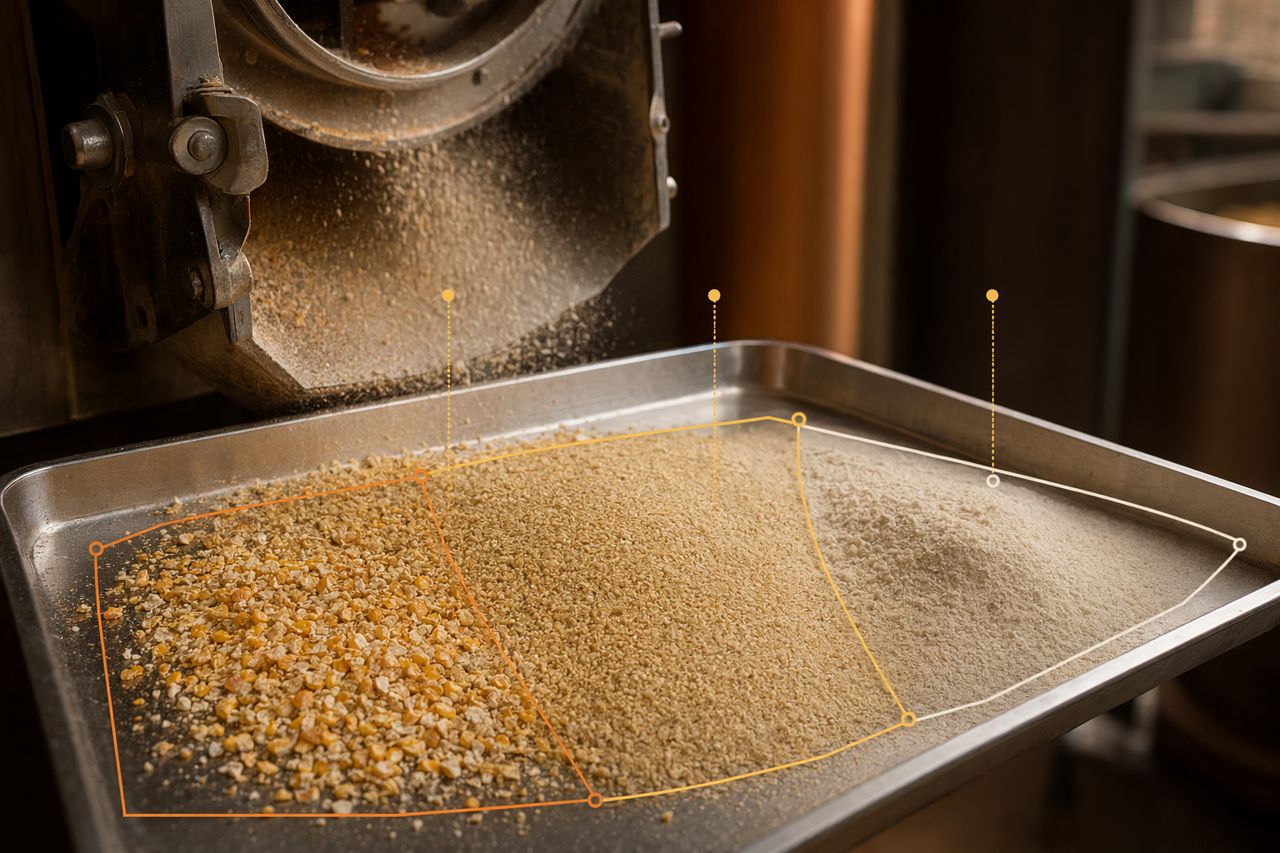
Milling is the first performance gate. Enzymes act where substrate is available. If grain is too coarse, starch can remain physically protected inside intact particles. If grind is too fine, the mash may become harder to move, harder to heat uniformly, and more prone to handling issues.
What production teams should watch
- Particle size distribution, not only average grind
- Hammermill screen wear and roll gap drift
- Flour fraction increases that raise viscosity and load pumps
- Whole or cracked kernels that pass through without full conversion
- Batch-to-batch grain variability in hardness and moisture
A practical enzyme program can help widen the operating window, but it cannot fully compensate for a grind profile that blocks water penetration or creates uneven thermal treatment.
2. Gelatinization is where many starch programs succeed or struggle
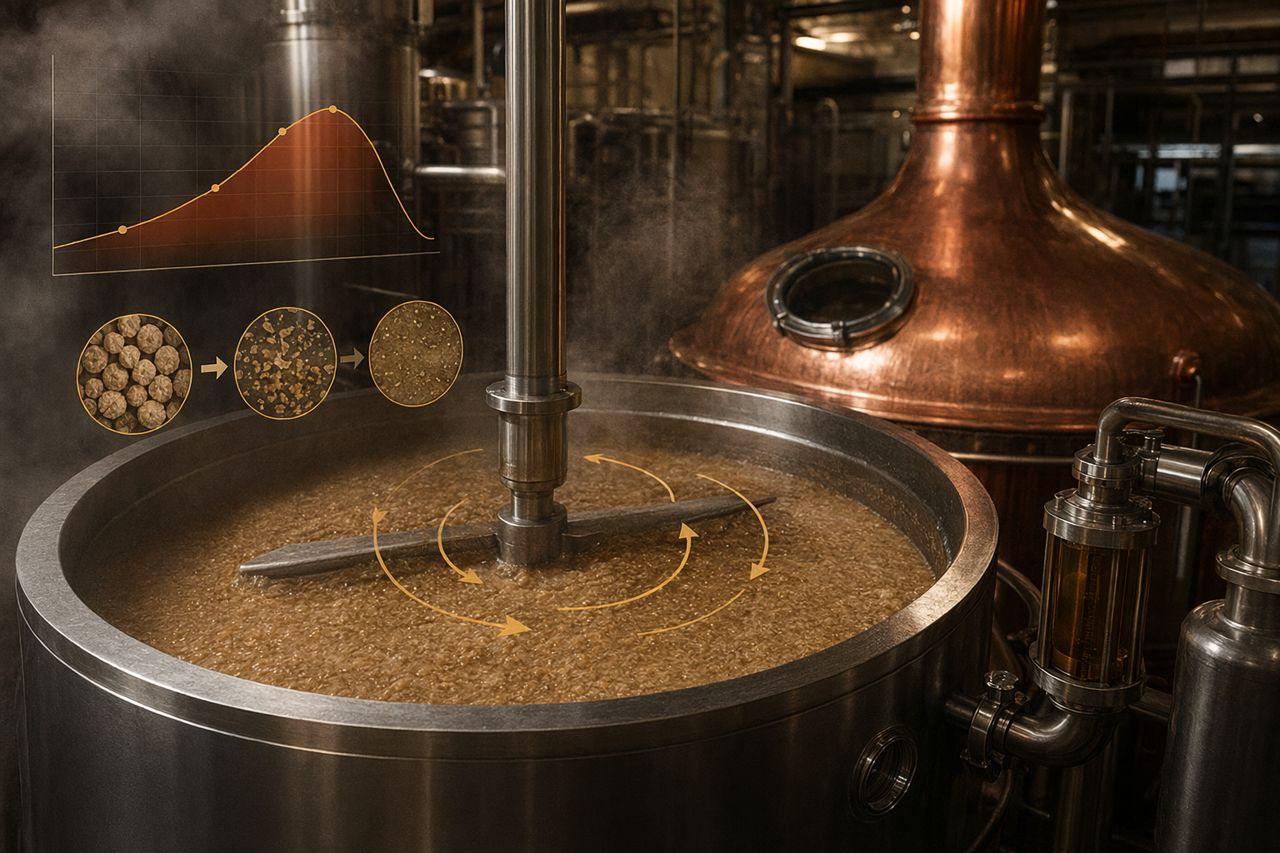
For starch-based spirits, the cooker or mash heating step determines how much starch becomes available for enzymatic conversion. If the starch is not properly gelatinized, downstream glucoamylase may see less accessible substrate. If the mash is overheated or held too long under harsh conditions, enzyme stability and process consistency can suffer.
Key cooker variables
- Heat-up rate
- Final cook temperature
- Hold time
- Solids loading
- Mash recirculation or agitation pattern
- Steam injection uniformity
- Grain type and starch structure
Corn, wheat, rye, barley, and other cereal bases do not behave identically. A cooker profile that works well for one mash bill may create viscosity or conversion problems in another.
3. Solids loading changes viscosity, mixing, heat transfer, and enzyme contact
Higher solids can support throughput and yield objectives, but they also change the physical environment. As solids rise, mash becomes thicker, heat transfer becomes less forgiving, and enzyme distribution becomes more dependent on mixing quality.
When viscosity increases, the enzyme may still be present, but it may not be reaching the substrate evenly. This can show up as inconsistent liquefaction, uneven fermentability, longer transfer times, or higher mechanical load on pumps and agitators.
Practical signs solids are pushing the system
- Slower tank turnover
- Agitator amperage creeping upward
- Reduced flow through heat exchangers
- Stratification in mash tun or cooker
- Hot spots, cold pockets, or uneven conversion
- More variable fermentation starts
The right enzyme selection can help manage viscosity and fermentability, but solids strategy should be matched to the equipment’s real mixing and transfer limits.
4. Temperature is not one number; it is a profile
Enzyme performance depends on exposure history, not just a single setpoint. A mash may briefly hit a target temperature while the tank still contains zones that are cooler or hotter than expected. The enzyme sees the actual process environment, including heat-up, hold, transfer, and cooling conditions.
Temperature questions worth asking
- Where is temperature measured?
- Does the probe represent the full vessel?
- Are there cold pockets near grain feed or corners?
- Are there hot zones near steam injection?
- How long is the enzyme exposed before the mash reaches its next step?
- Does transfer piping add unexpected residence time at elevated temperature?
For distilleries running tight production windows, temperature control is often the difference between repeatable conversion and batch-level correction.
5. pH and backset can shift the reaction environment
Backset and process water are more than dilution streams. They carry acidity, minerals, residual organics, and buffering effects that can shift the environment where enzymes operate.
A pH that looks acceptable at one point in the process may move after grain addition, backset blending, heating, or cooling. This matters because enzymes have practical working ranges. Outside those ranges, conversion may slow, viscosity reduction may be incomplete, or fermentability may become less consistent.
Watch points for pH control
- Backset inclusion rate
- Backset variability between runs
- Water source and mineral profile
- Mash bill changes
- Acid additions or pH correction timing
- pH measurement temperature and sampling consistency
Enzymeedge typically evaluates enzyme fit against the actual mash environment rather than relying on idealized bench conditions.
6. Agitation determines whether the enzyme is actually working everywhere
Good agitation does more than suspend grain. It supports heat transfer, hydration, enzyme distribution, and consistent substrate contact. Poor mixing can make an adequate enzyme dose look underpowered because parts of the vessel are not receiving the same conditions.
Common agitation-related problems
- Enzyme added into a low-flow zone
- Powder or liquid additions not dispersing quickly
- Grain rafts or settled solids
- Incomplete wet-out at high solids
- Recirculation loops that bypass dead zones
- Vortexing without full vessel turnover
If enzyme response changes when fill volume, mash bill, or solids level changes, mixing should be part of the investigation.
7. Addition point and sequence affect outcome
The timing of enzyme addition matters because the mash changes quickly during cook, liquefaction, cooling, and saccharification. Adding too early, too late, or into the wrong process zone can reduce practical performance.
Sequence considerations
- Liquefaction enzyme placement relative to gelatinization
- Viscosity-reducing enzyme timing before transfer constraints appear
- Saccharification enzyme timing relative to cooling and fermentation preparation
- Compatibility with acid adjustments or backset blending
- Whether enzymes are exposed to avoidable high-temperature residence
- Whether the addition point provides fast dispersion
The goal is to put each enzyme into the process where it can deliver measurable value without creating operational risk.
8. Raw material variability can make the same program feel different
Distilleries often experience seasonal or supplier-driven changes in grain behavior. Moisture, protein, damaged starch, beta-glucans, arabinoxylans, and kernel hardness can all influence mash viscosity and fermentability.
This is especially relevant for operations using rye, wheat, barley, or mixed grain bills where non-starch polysaccharides can create heavy mash behavior. In these cases, supporting enzymes such as beta-glucanase, xylanase, or protease may be useful alongside starch-conversion enzymes, depending on the process target.
9. Cleaner separations start upstream
Distillation performance is connected to mash preparation and fermentation consistency. When conversion is uneven, fermentation may become less predictable. When viscosity is high, transfer and solids handling can become less stable. When residuals vary, still feed behavior can shift.
A well-matched enzyme program supports:
- More consistent fermentable extract
- Improved mash mobility
- Better transfer reliability
- Reduced batch-to-batch correction
- More predictable fermentation kinetics
- Cleaner still feed handling
- More stable operating decisions at cut points
Enzymes are not a substitute for disciplined process control, but they can strengthen the control window when selected around real equipment behavior.
10. How to troubleshoot enzyme performance before changing the program
Before assuming the enzyme is the issue, review the variables that define its working environment.
Plant-floor troubleshooting checklist
- Confirm grind profile and recent mill changes.
- Check cooker temperature mapping, not only the main setpoint.
- Review solids loading and recent throughput changes.
- Verify pH after grain, backset, and heat effects are present.
- Inspect agitation pattern and addition-point dispersion.
- Compare backset inclusion and quality between runs.
- Review residence time during cook, transfer, and cooling.
- Look for mash bill or grain supplier changes.
- Compare fermentation start behavior against mash viscosity and conversion data.
- Confirm enzyme storage, handling, and addition sequence.
This type of review often reveals whether the right answer is an enzyme change, a sequence adjustment, a process correction, or a combined approach.
What Enzymeedge brings to the discussion
Enzymeedge supports beverage alcohol distilleries with enzyme programs built around production realities: cookers, mills, mash tuns, fermenters, transfer lines, and still feed behavior. We focus on practical outcomes that matter to production managers and technical leads.
Typical objectives include
- Faster and more reliable liquefaction
- Controlled mash viscosity
- More consistent fermentability
- Better handling at higher solids
- Reduced process variability
- Improved batch-to-batch confidence
- Cleaner upstream preparation for separation
We help match enzyme selection and addition strategy to your mash bill, equipment, thermal profile, pH environment, solids target, and operating constraints.
Request a quote
If your team is evaluating enzyme support for spirit production, share your mash bill, process flow, solids target, current pain points, and production objectives. Enzymeedge can recommend a practical enzyme approach for your equipment and operating window.