Enzyme for Grain Spirit Distillery Operations
A grain spirit plant earns its margin in the mash: how fast it thins, how completely the starch converts, and how predictably the fermenters finish. When the grain bill changes, from corn to wheat, rye, barley or sorghum, or from one crop year to the next, the enzyme program has to keep up or the plant pays in slow transfers, long tank occupancy and lost alcohol.
Enzymeedge works with grain spirit distilleries, contract distillers and the distributors who supply them to match the enzyme system to the grain, cook profile, pH window, hold time and solids level. Supply is by quotation: send the product or process step, the quantity and the delivery destination.
Built for production managers, not brochure claims
In grain spirit production, enzyme selection has to serve the operating plan. Enzymeedge helps distilleries evaluate enzyme programs around measurable plant-floor outcomes:
- Improved starch liquefaction and saccharification control
- More consistent fermentable sugar availability
- Lower mash viscosity for easier pumping, heat transfer, and tank turnover
- Reduced process drag from high-solids or variable grain quality
- Better fermentation consistency across batches and campaigns
- Cleaner downstream handling where mash separation or still feed behavior matters
- Practical support for scaling from trial runs to routine production
We keep recommendations grounded in your equipment, grain handling, cook system, fermentation residence time, and production targets.
What changes with the grain bill
Different grains bring different problems into the mash. The table below is a starting point for the conversation, not a recipe: the right program still depends on your cook, solids and fermentation plan.
| Grain bill | Usual pressure point | Where enzyme support is usually focused |
|---|---|---|
| Corn-led mashes | High starch load, thick mash during and after cooking | Liquefaction for viscosity control, then saccharification for fermentable sugar |
| Wheat-heavy mashes | Viscosity and sticky handling at higher solids | Liquefaction plus non-starch viscosity support |
| Rye-forward mashes | Fast viscosity build-up, foaming and difficult transfers | Non-starch viscosity support alongside starch conversion |
| Barley and sorghum | Beta-glucan from the grain cell walls thickening the mash and slowing separation | Beta-glucanase alongside starch conversion, chosen for your mash temperatures |
| Mixed or changing grain lots | Results drift from one delivery to the next | A program that tolerates variation, plus batch records to separate grain from enzyme effects |
Enzyme functions for grain spirit mash conversion
Liquefaction support
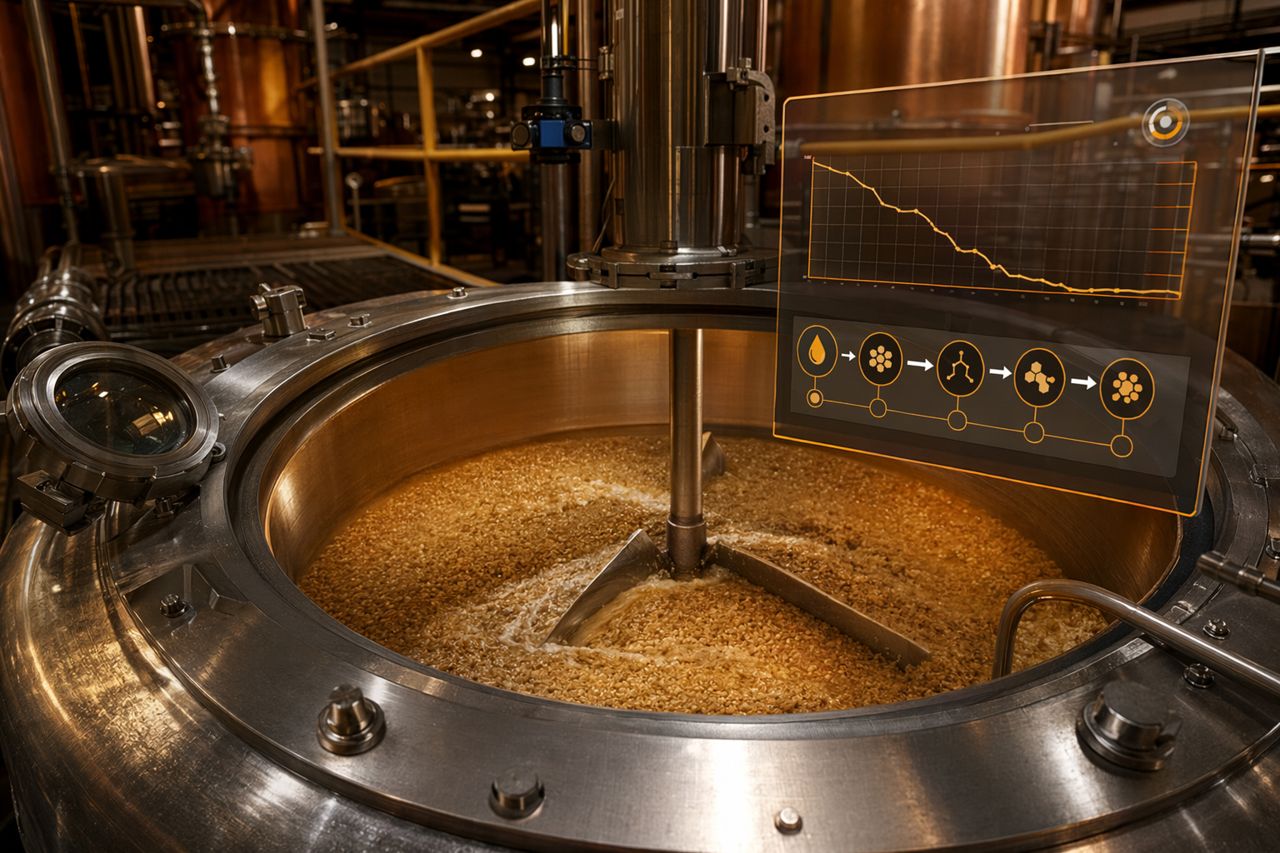
High-viscosity mash can slow transfers, strain agitators, reduce heat transfer efficiency, and create inconsistent cook behavior. A liquefaction enzyme program helps break down gelatinized starch into shorter-chain material so the mash moves more predictably through the process.
For production teams, the value is simple: fewer viscosity surprises, more stable pumpability, and better control before fermentation.
Saccharification and fermentability
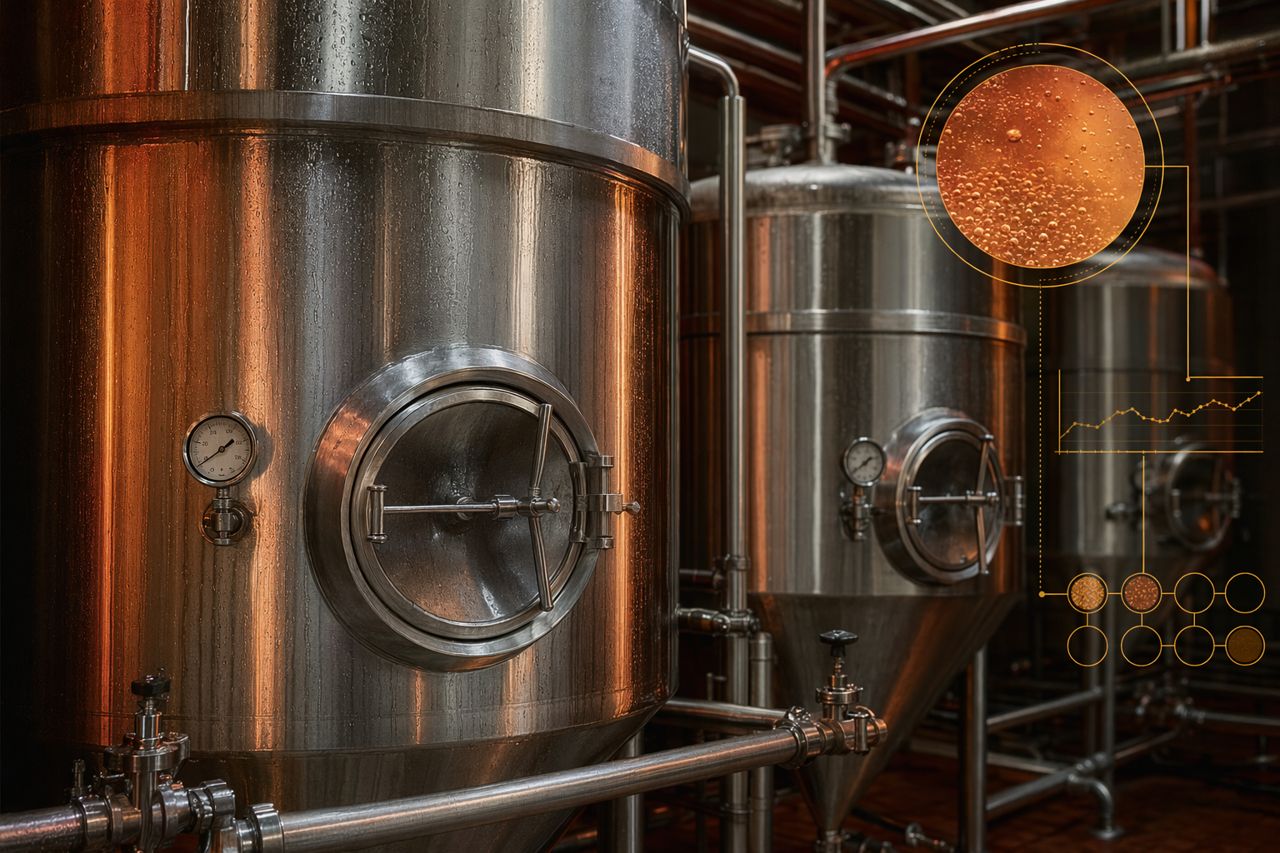
Fermentation performance depends on the availability of usable sugars. Saccharification-focused enzymes help convert liquefied starch fractions into fermentable carbohydrates that yeast can utilize more consistently.
Enzymeedge helps align saccharification support with your fermentation target, grain bill, residence time, and operational preferences so sugar release supports the yeast instead of creating avoidable variation.
Viscosity and non-starch grain components
Some grain bills bring additional process challenges from beta-glucans, arabinoxylans, proteins, and fiber-associated material. Depending on the substrate and plant objective, supporting enzyme activities may be used to improve mash flow, solids handling, or separation behavior.
This is especially relevant for rye-heavy, wheat-heavy, barley, sorghum or mixed grain operations where viscosity can shift quickly with raw material changes. Because these enzymes work in a hot mash, ask how each product holds up at your actual mash temperatures before you compare prices.
Where Enzymeedge fits in your process
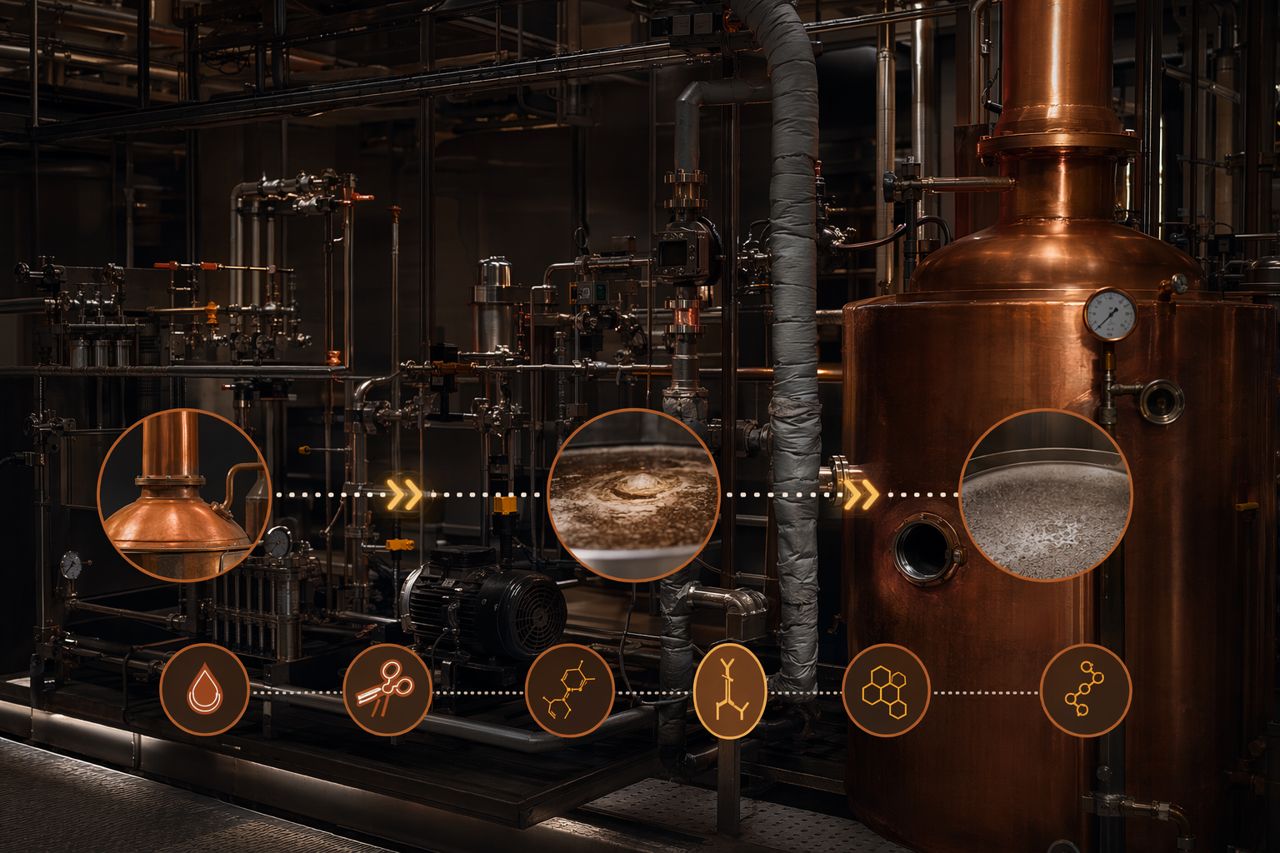
Enzymeedge supports enzyme selection and supply for key grain spirit production stages:
- Grain slurry and mash preparation
- Cooking and gelatinization support
- Liquefaction and viscosity reduction
- Saccharification and fermentable sugar development
- Fermentation consistency improvement
- Downstream handling, still feed preparation, or solids separation support where applicable
We do not force a generic package onto every plant. A bourbon-style corn mash, wheat spirit operation, rye-forward program, and neutral grain spirit facility can require different enzyme priorities. The right answer depends on your grain, process temperature profile, tank utilization, yeast plan, and target throughput.
Buying enzymes for throughput and consistency
When enzyme performance is inconsistent, the cost is rarely limited to ingredient spend. Production teams may see longer tank occupancy, slow transfers, inconsistent attenuation, higher residual starch, foaming or handling issues, or more operator intervention.
Questions worth answering before you buy:
- How quickly does the mash reach a pumpable, controllable state today?
- Is fermentation feedstock consistent enough for predictable yeast performance?
- Do batch records show avoidable variation in conversion or attenuation?
- Are high-viscosity runs slowing production schedules?
- Is raw grain variability creating process instability?
- Could enzyme selection reduce rework, waiting time, or manual correction?
That is where a distillery enzyme program earns its place: in steadier runs, tighter process control, and fewer surprises between mash and still.
Common mistakes in grain spirit enzyme programs
- Using one program for every grain bill, then blaming the enzyme when a rye or barley run thickens.
- Comparing products on price per kilo instead of on transfer time, residual starch and fermentation finish.
- Changing grain lots and enzyme products in the same week, so nobody can tell which change caused the result.
- Treating non-starch viscosity as a pump or equipment problem when it starts in the grain.
Technical supply with plant-floor communication
Enzymeedge works with distillery teams that need more than a catalog item. We can help define a practical trial structure, review process conditions, and recommend enzyme options for your production objective.
Typical information reviewed includes:
- Grain bill and raw material variability
- Milling profile and solids level
- Cook temperature pattern and hold times
- Mash pH range
- Fermentation time and yeast requirements
- Current viscosity, transfer, or conversion issues
- Desired changes in throughput, consistency, or handling
- Existing process constraints that cannot be changed
From there, we help identify an enzyme system suited to your plant rather than asking your plant to adapt to an off-the-shelf assumption.
Why production teams choose Enzymeedge
- Technically fluent support for grain spirit processes
- Practical focus on plant constraints and operator realities
- Enzyme selection based on mash behavior and fermentation targets
- Clear communication for purchasing, production, and technical staff
- Supply conversations built around continuity, repeatability, and scale
- No lifestyle spirits language, no inflated promises, just process value
Request a quote: wholesale and bulk supply
Enzymeedge supplies enzymes for grain spirit production in wholesale and bulk quantities to distilleries, contract distillers, manufacturers, resellers and distributors. Pricing, pack format and delivery are quoted per order.
Use the on-site request a quote form and include:
- Product: the enzyme or process step, or the problem you want solved
- Quantity: per order and per month or quarter
- Destination: delivery country and city
- Your grain bill, process stage, current challenge and target outcome
We will review the details and respond with a practical enzyme supply recommendation for your operation.